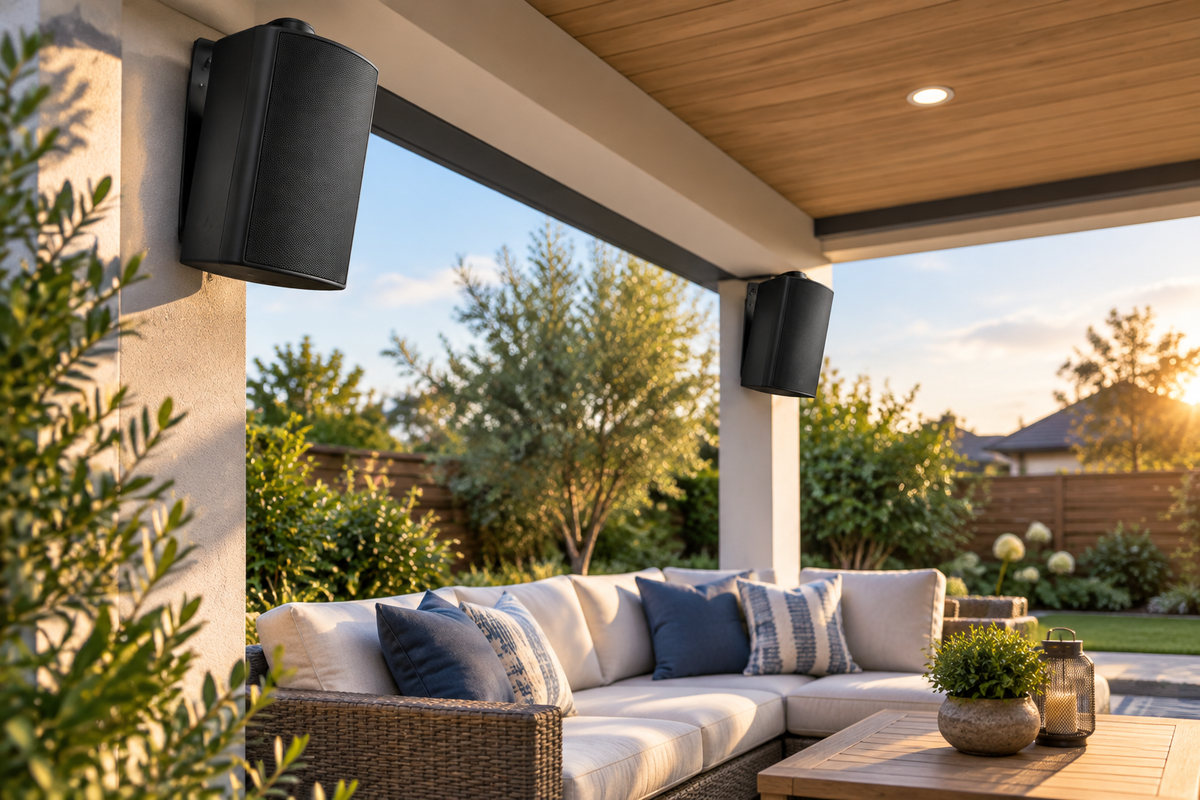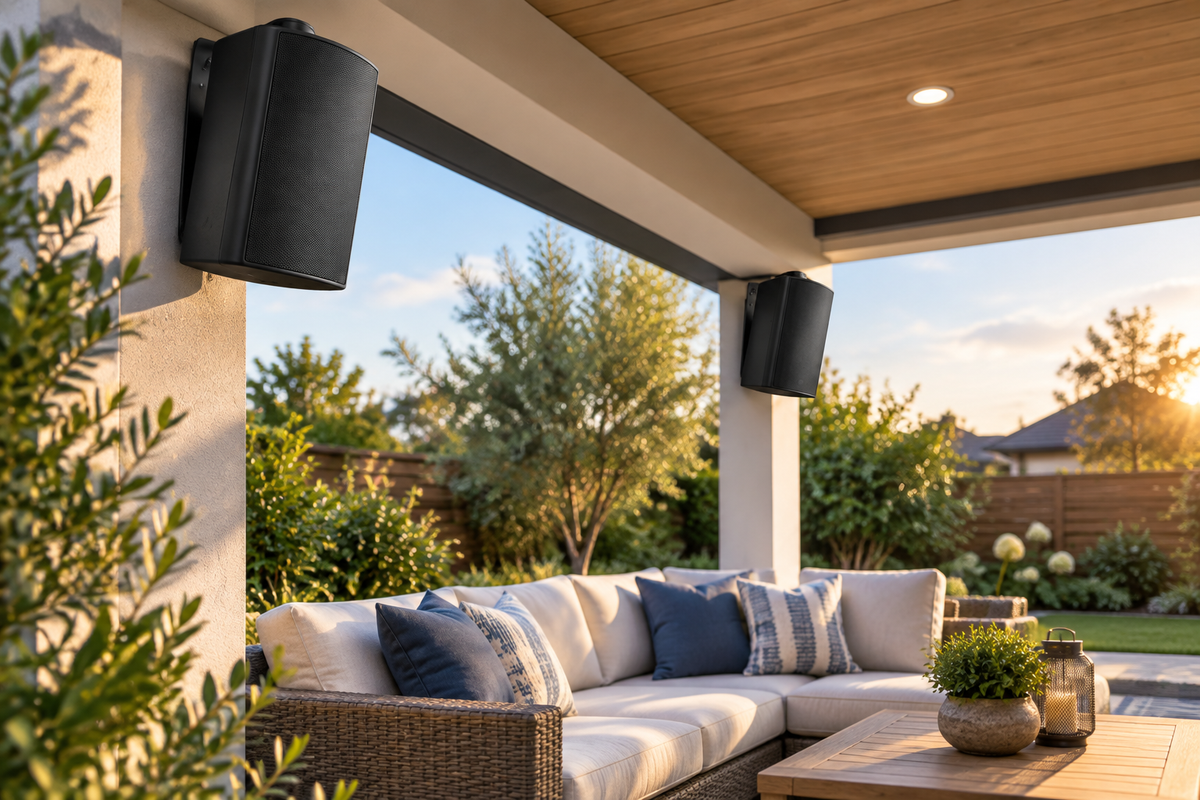
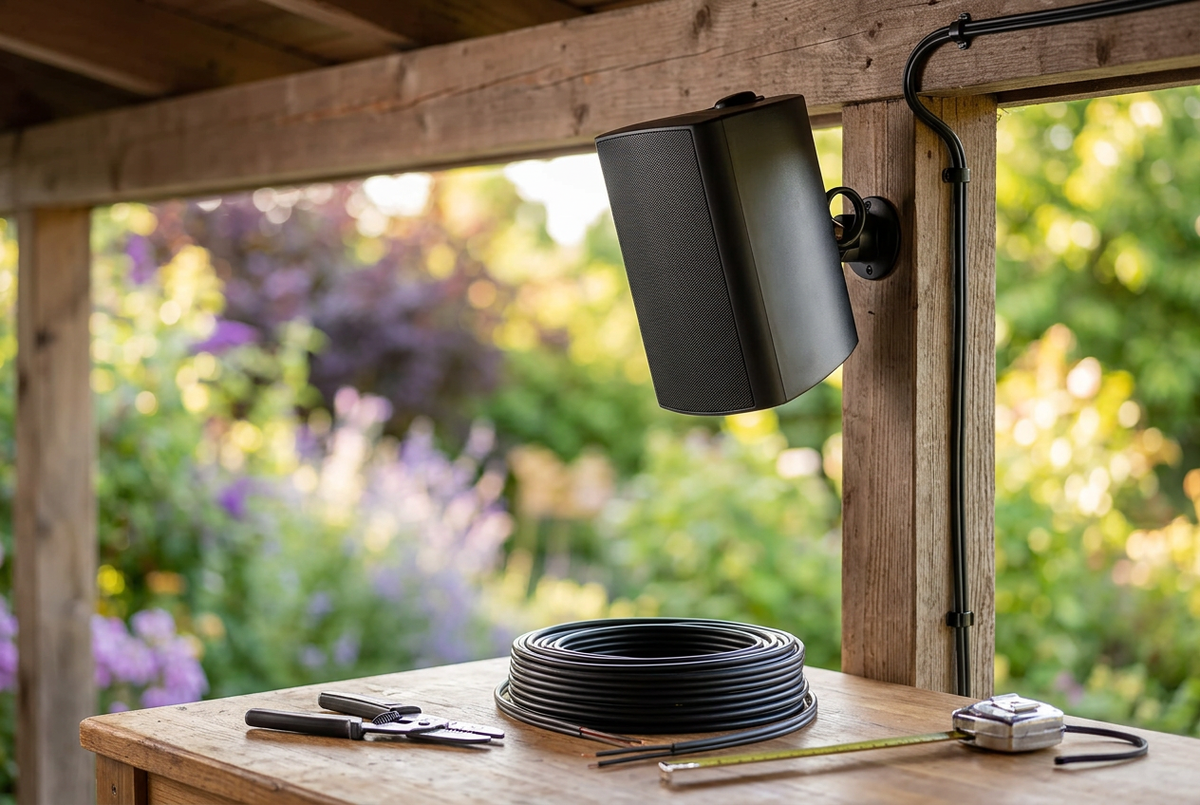
A reliable patio audio system needs more than weather-resistant speakers. The cable connecting your speakers to the amplifier must suit the distance, the installation route and the environment. Choosing wire only by price or using whatever is left in a drawer can create avoidable problems.
This guide explains how to plan outdoor speaker wire for wall-mount speakers and backyard listening areas. It focuses on speaker-level audio cable, not mains electrical wiring or power-adapter extension leads.
1. Identify Which Connections Need Speaker Wire
Passive speakers receive power and audio from an amplifier through speaker cable. Each connection must follow the amplifier and speaker manufacturer's wiring instructions.
Bluetooth systems can need speaker wire too. Bluetooth carries the music signal from your phone to the receiver, but it does not necessarily connect every speaker wirelessly. Herdio's Bluetooth outdoor wall-mount range uses different layouts by pack: one-pair options have an active speaker and passive partner, while two-pair options include a separate amplifier.
Before buying cable, locate the powered component and draw the connections shown in your exact pack's manual. Do not assume every speaker needs its own power adapter or that every speaker pairs directly with your phone.
2. Measure the Real Cable Route
Measure along the route the wire will actually follow. Include vertical sections, turns around posts, wall-entry points and the path to the amplifier. A straight-line measurement across the patio can underestimate the cable you need.
Leave enough slack for secure connections and future adjustment without leaving loose loops hanging outdoors. Label the routes for left and right speakers, or for each amplifier output, before installation.
For a four-speaker layout, measure every run separately. Do not assume that buying four speakers provides independent zones, or that additional speakers can be connected to the same output without checking the amplifier's supported load.
3. Understand Wire Gauge
American Wire Gauge, or AWG, describes conductor size. A lower AWG number means a thicker conductor: 14 AWG is thicker than 16 AWG. Thicker conductors generally have lower resistance over the same length.
The appropriate gauge depends on cable length, conductor material, speaker impedance and the amplifier's guidance. Longer runs make cable resistance more important. There is no single gauge recommendation that fits every patio system.
Use the cable-selection guidance supplied with your amplifier and speakers. If the manuals do not specify a suitable gauge for your planned distance, ask the manufacturer or a qualified audio installer rather than applying an arbitrary distance chart.
Check conductor material as well as gauge. Copper-clad aluminum and copper conductors do not have identical resistance at the same nominal size. Compare the cable's actual specifications rather than treating matching AWG labels as proof of equivalent performance.
4. Choose Ratings for the Route
Exposed Outdoor Runs
For cable exposed to sunlight or weather, look for manufacturer documentation stating that the cable is suitable for those conditions. An indoor cable does not become outdoor-rated simply because the speaker is weather-resistant.
Runs Through Walls
Check whether the cable is approved for the intended in-wall use and whether additional requirements apply where it passes outdoors. An in-wall designation alone is not a guarantee of UV resistance or suitability for burial.
Underground Routes
Do not bury ordinary speaker wire. A buried route needs a cable and installation method approved for that use. Direct-burial suitability is a separate specification from general outdoor suitability. Conduit also does not automatically make an unsuitable cable appropriate, because moisture can collect inside it.
Have a qualified installer assess buried routes, wall penetrations and any electrical work. Keep speaker cable separate from mains wiring as required for the installation; do not improvise a shared route.
5. Check the Included Cable Before Ordering More
Herdio's passive outdoor wall-mount product listing specifies included speaker wire with its packs. Bluetooth pack contents differ by size and configuration. Check the exact variant's box contents, then compare the supplied cable length with your measured route.
Included cable may be enough for a compact setup, but it is not proof that every longer, exposed or buried route is covered. Confirm the supplied cable's installation rating before using it outside the conditions described in the manual.

Herdio Passive Outdoor Speakers
Choose from 4-inch, 5.25-inch and 6.5-inch options in one-pair or two-pair packs. A compatible external amplifier or receiver is required and is not included. Check the exact pack's wiring requirements before installation.
6. Protect Connections and Keep Polarity Consistent
Disconnect system power before making or adjusting connections. Follow the manual's positive and negative terminal markings consistently. Reversing polarity on one speaker can affect the way the pair sounds together.
Strip only the amount of insulation needed for the terminal. Secure the conductor without leaving loose strands that could bridge neighboring terminals. Use connectors suitable for the equipment and environment; do not assume a covering of ordinary tape creates a weatherproof connection.
Support cable so it is not pulled tight at the terminals. Avoid sharp bends, pinch points and fasteners that damage the jacket. Where an exterior entry or connection needs water protection, use an appropriate installation method and seal rather than relying on the speaker enclosure's rating.
7. Speaker Wire Is Not a Power Extension Cable
Speaker cable is intended for the amplifier-to-speaker connection. Do not use it to extend a power adapter or replace a mains lead. Power extensions must match the equipment's electrical requirements and their intended environment.
A Bluetooth system still needs suitable power access, and an outdoor speaker's weather rating does not automatically apply to its adapter or amplifier. Keep powered electronics appropriately protected and ventilated.

Herdio Bluetooth Outdoor Speakers
Stream from your phone while using the supplied amplification arrangement for your chosen pack. Review the active/passive or separate-amplifier layout, cable contents and power requirements.
8. Test Before Finishing the Installation
Once connections are secure, test at low volume before closing up or concealing the route. Confirm that every speaker plays clearly and that channel assignments are correct. Power off again before correcting wiring.
Listen from the actual seating positions. If sound is uneven, examine speaker placement and balance as well as the cable connections. Increasing amplifier volume is not a substitute for fixing a loose terminal or unsuitable system layout.
Frequently Asked Questions
Can I use indoor speaker wire outside?
Only use cable documented as suitable for its intended conditions. Check outdoor exposure, sunlight, moisture and any wall or burial requirements separately.
Does Bluetooth mean I can skip speaker cable?
Not always. An active/passive pair or a separate-amplifier pack may still need cables between the powered component and the speakers.
Is thicker wire always better?
It can reduce resistance, but it must also fit the terminals and suit the installation. Choose according to run length, conductor specifications and the equipment manufacturer's guidance.
Can I join two cables to make a longer run?
A suitable continuous run can avoid an additional connection point. If a joint is necessary, use a method approved for the cable and environment, with appropriate protection and strain relief. Do not leave an improvised splice exposed to weather.
Your Outdoor Wiring Checklist
- Identify every required speaker-level and power connection.
- Measure each real route, including vertical sections and turns.
- Choose gauge and conductor material using equipment guidance.
- Confirm ratings for outdoor, in-wall or buried sections.
- Check included cable length and documented suitability.
- Keep terminals secure and polarity consistent.
- Protect power equipment separately from the speakers.
- Test at low volume before finishing the route.
Plan the wire at the same time as the speakers, not after mounting them. A suitable cable route and careful connections give your patio or backyard system a cleaner installation and make future troubleshooting easier.