Your outdoor speakers play clearly, but the music feels thinner than it does inside. Before buying a bigger amplifier or turning up the bass control, look at the listening area, speaker placement and wiring.
Outdoor listening is different from listening in a room. This guide explains why, then walks through practical checks for a fuller, more balanced patio sound. It applies to both Bluetooth speaker systems and passive speakers connected to a compatible amplifier.
Why Bass Can Feel Weaker Outdoors
Inside a room, nearby walls and other surfaces affect the sound that reaches you. In an open yard, there are fewer boundaries to provide that reinforcement. Listening farther from the speakers can also make the music feel less substantial, especially against background noise.
A small outdoor speaker cannot be expected to reproduce the deepest bass like a dedicated subwoofer. The goal is clean, balanced sound at the seats where you actually listen, not indoor-room bass across an entire property.
1. Listen Close Before Changing Anything
Play a familiar track at a moderate level and listen near each speaker. Then listen from the patio seating area. If the sound is full nearby but thin at your usual seat, placement and listening distance deserve attention before you change the equipment.
Use a normal music track rather than an extreme bass test. Try a second track too: recordings have different bass balances, and a single track is not a reliable test of the whole system.
If one speaker sounds noticeably different from the other, inspect that channel and its connection before applying equalization to both.
2. Aim Toward the Listening Area
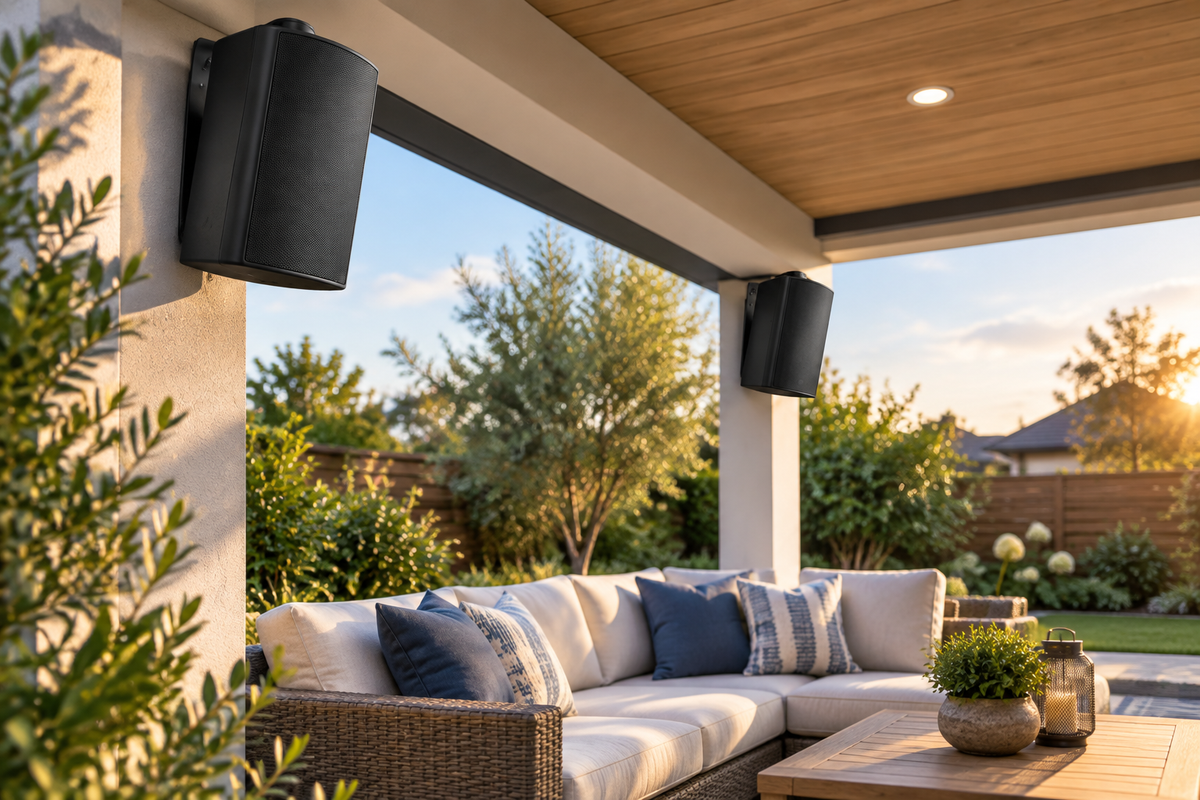
Speakers mounted far above or pointed away from the seats can make the overall sound feel distant or uneven. Use the bracket's permitted adjustments to direct the speakers toward your main listening zone. Follow the model's mounting instructions and keep the bracket secure.
Try modest angle changes and listen again from the seats. Do not assume that moving a speaker to the highest available point improves coverage. Keeping the listening area reasonably close to the speakers can be more useful than increasing volume.
A sheltered position near a solid wall may change the tonal balance, but the result depends on the speaker and surroundings. Test the planned position, preserve required clearance and weather protection, and avoid promising a particular bass gain from any mounting distance.
3. Check Wiring Polarity
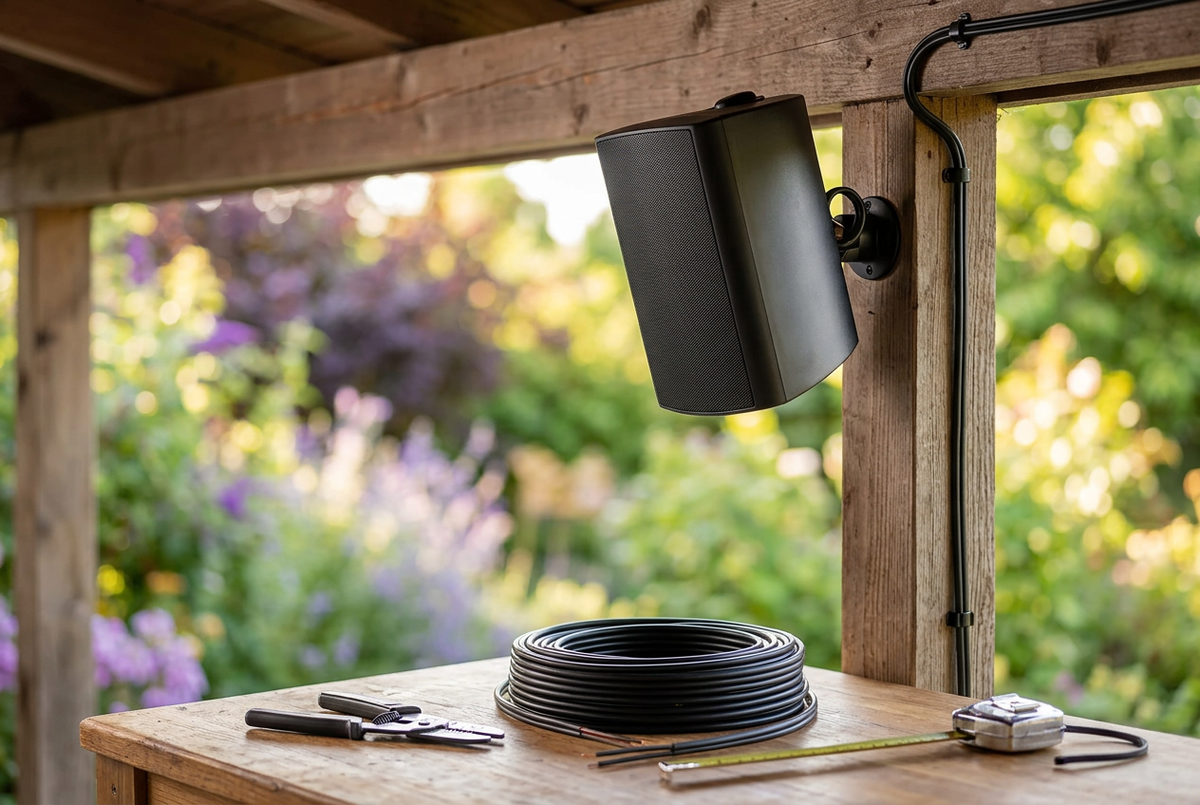
If a pair sounds thinner together than you expect, inconsistent wiring polarity is worth checking. Switch off and disconnect system power before touching speaker terminals.
Follow the positive and negative markings on the amplifier and each speaker. Keep the connections consistent across the pair, and use the cable's identification marking to track each conductor. Do not rely on jacket color alone unless it matches the cable's documentation.
In an active/passive Bluetooth pair, check the cable to the passive partner. In a separate-amplifier pack, check each amplifier-to-speaker run. If you are unsure of the correct terminals, use the exact model's wiring diagram rather than experimenting with powered connections.
4. Start with Neutral Tone Settings
Check both the source device and amplifier for equalizer settings. An app preset, phone effect and amplifier bass boost can stack together, making troubleshooting confusing.
Begin with neutral settings where available. Listen again, then make small changes one at a time. Excessive bass boost can push an amplifier or speaker into distortion without producing useful deeper bass.
If you hear harshness, rattling or obvious distortion, reduce volume and bass boost. Do not keep turning up the control to compensate. Also check for loose mounting hardware or nearby objects vibrating before assuming the driver is damaged.
5. Match the Amplifier to the Speakers
Passive outdoor speakers need an amplifier or receiver compatible with the exact model's impedance and power requirements. The largest advertised wattage is not automatically the right match.
Herdio's passive outdoor wall-mount range includes 4-inch, 5.25-inch and 6.5-inch packs. The amplifier is not included. Consult the selected variant's specifications, especially when adding more speakers or changing connections.
Peak pack ratings are not continuous operating targets. Adding another pair can change the electrical load depending on how it is wired. Do not connect additional speakers in parallel unless the amplifier supports the resulting load.

Explore Herdio Passive Outdoor Speakers
Compare 4-inch, 5.25-inch and 6.5-inch options for a wired patio setup. Choose the size and pack around your listening area and a compatible external amplifier.
6. Separate Coverage Problems from Bass Problems
If one end of the patio sounds good and the far end sounds weak, you may have a coverage problem. A better-distributed speaker layout can provide more consistent listening than forcing one pair to cover every seat at high volume.
More speakers do not automatically extend the system's deepest bass, and four speakers do not automatically provide independently controlled zones. Plan the amplifier outputs and wiring before expanding the system.
Keep sound aimed into your own gathering area and consider neighbors. A comfortable, even listening level is a better target than maximum output across the yard.
7. Decide Whether a Larger Speaker Makes Sense
After checking placement, wiring and settings, compare speaker sizes. A larger woofer and cabinet may be worth considering for greater bass presence, but diameter alone does not determine performance. The model's design, amplification and listening distance still matter.
Herdio's Bluetooth outdoor range offers 4-inch, 5.25-inch and 6.5-inch configurations. One-pair packs use an active/passive arrangement, while two-pair packs include a separate amplifier. Check the exact variant's features and connection layout before replacing your current setup.

Explore Herdio Bluetooth Outdoor Speakers
For convenient phone streaming with amplification supplied as part of the selected pack. Compare sizes and pack layouts rather than choosing only by peak wattage.
Frequently Asked Questions
Will turning up the volume improve bass?
It raises playback level, but it does not correct polarity, poor placement or a speaker's low-frequency limits. Reduce the level if the system distorts.
Does Bluetooth itself explain weak bass?
Do not assume so. Check the recording, source settings, speaker placement and system connections first. Where a supported alternate input is available, comparing it can help narrow down the cause.
Can I add a subwoofer to any outdoor system?
No. Check whether the amplifier has suitable outputs and whether the proposed subwoofer and connection are compatible. Any equipment placed outdoors must suit the location. Do not connect an unsupported subwoofer to ordinary speaker terminals by guesswork.
Should I buy more speakers or larger speakers?
More speakers can help distribute coverage; a different speaker design may better suit your tonal expectations. Identify whether the problem is uneven coverage or limited bass before spending more.
A Simple Improvement Checklist
- Compare the sound near the speakers and at the seats.
- Aim speakers toward the listening area.
- Check wiring polarity with power disconnected.
- Start with neutral EQ and make small adjustments.
- Confirm amplifier compatibility with the selected pack.
- Plan additional coverage before adding speakers.
- Keep volume clean and comfortable.
For fuller patio sound, start with the setup you already have. Placement, consistent wiring and sensible settings are the first checks. Upgrade only after identifying what your system actually needs.